

What does a founder-led sales process look like?
A founder-led sales process is a simple, repeatable routine for finding potential buyers, having useful conversations, following up, and recording what you learn. It is both a way to generate revenue and a way to test your assumptions about the market.
This post is a working plan for putting that routine on your calendar. You do not need a polished sales deck or a complicated customer relationship management (CRM) system to start. You do need a clear target, a good reason to contact someone, and a reliable way to follow through.
Founder-led sales is when a company’s founder personally leads early sales conversations and decisions, using direct customer interaction to find a viable buyer, problem, message, and buying process.
Think of the process as a loop:
Choose a group of likely buyers.
Reach out with a relevant reason to talk.
Ask about their current problem and what they do about it.
Agree on a specific next step when there is a fit.
Record what happened and adjust your approach.
The goal is not to sound like a career salesperson. It is to understand whether someone has a problem you can solve, whether they care enough to act, and how they make a decision.
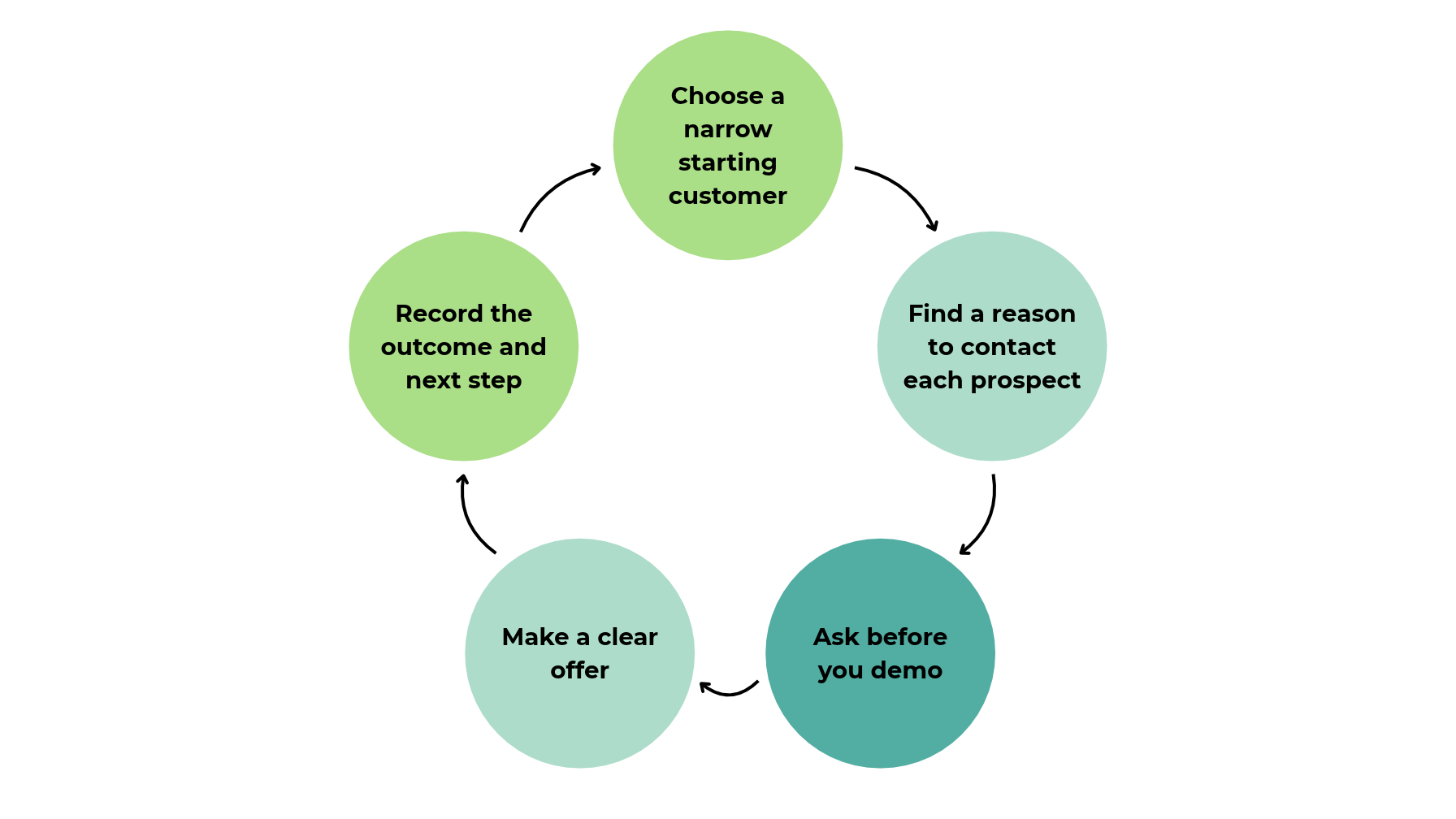
Founder-led sales learning loop.
How do you find the right first customers?
Start with a narrow set of people who are likely to feel the problem, not a broad list of anyone who might use your product.
Write down your best current guess about your ideal customer profile (ICP). Keep it specific enough to guide your outreach. For example, identify a type of company, a role that experiences the problem, and a situation that may make the problem urgent. “Technology companies” is too broad. “Operations leaders at growing companies still managing a critical workflow through spreadsheets” gives you somewhere to start.
Then build a first list of 10–15 people or accounts. For each one, note:
Why might this person have the problem?
What suggests it matters now?
How can I reach them, directly or through a trusted introduction?
What do I want to learn from the conversation?
Your network can be a useful starting point, especially when you have not yet established a repeatable source of demand. But do not treat a friendly introduction as proof of market interest. The test is what the buyer does: do they explain a real problem, involve the right people, share information, or commit to a next step?
In a first conversation, ask about something that has already happened. “Tell me about the last time this problem came up” will usually teach you more than “Would you use a tool that does this?” Follow up with questions about the impact, their current alternative, who is involved, and why they might address it now.
What should your week actually look like?
A useful starting rhythm is to set aside recurring time for outreach, conversations, follow-up, and review. Treat the activity counts below as a first experiment, not a universal quota. Adjust them to your sales cycle and the number of hours you can protect.
Monday: Pick the focus. Choose 10–15 high-fit people or accounts. Write down your reason for contacting each one, then review open opportunities. Any active opportunity should have a clear next step and a date.
Tuesday: Do focused outreach. Set aside an hour for tailored emails, introductions, or other relevant outreach. A starting target might be about 20 new touches across the week, not 20 generic messages in one sitting. Make the message about the buyer’s situation, not a list of product features.
Wednesday: Hold discovery calls. Use your conversations to understand the buyer’s current process, the last time the problem caused difficulty, what they have tried, and what happens if they do nothing. Share your perspective when it is useful, but do not turn every call into a pitch.
Thursday: Follow up and continue outreach. Send a brief recap after conversations. Confirm the problem as you understood it, the action each person agreed to take, and when you will reconnect. Keep prospecting even when one opportunity feels promising.
Friday: Review and learn. Update your deal notes, send any outstanding follow-ups, and spend 30 minutes looking for patterns. Which kinds of buyers responded? Which problems came up more than once? Where did conversations stall?
After every meaningful interaction, log the buyer’s words, the problem, the current alternative, the people involved, any objection, and the next step. A spreadsheet is enough at first. The point is to keep details you can compare, not to create extra administrative work.
How do you know it's working?
Look for evidence that buyers are moving through a process, not just agreeing that your idea sounds interesting. A positive conversation without a follow-up commitment is not the same as an active opportunity.
Keep a small set of stages with observable exit conditions. For example:
Contacted: You sent a relevant message or made an introduction.
Responded: The buyer replied and showed enough interest to continue.
Discovery complete: You understand the problem, current approach, and who is involved.
Next step agreed: Both sides have a specific action and date.
Proposal sent: The buyer has received a defined offer to consider.
Closed: The buyer has made a decision.
At the end of each week, review where opportunities are getting stuck. If people take calls but do not agree to a next step, you may be talking to the wrong person, failing to identify urgency, or moving to a pitch before you understand the problem. If conversations advance but proposals do not close, examine the offer, decision process, price, and alternatives.
Separate confirmed revenue from verbal interest. That distinction helps you make better decisions about hiring, spending, and product priorities. In my experience, a from-scratch sales build produced $80M in year-one revenue at Rockwell Automation, and I led work at Microsoft that increased Dynamics 365 pipeline by 85%. Those outcomes came from specific contexts; they are not targets for your startup. The practical lesson is to connect activity and strategy to real evidence.
What do founders get wrong about selling?
Founders usually get selling wrong when they treat it as a performance instead of a way to find out whether there is a real fit. A polished pitch cannot tell you whether someone has a problem worth solving.
The traps I see most often:
Leading with a product tour. Ask about the buyer's situation first, then show only the parts of the product that connect to what they told you.
Taking compliments as proof of demand. “That's interesting” is not a commitment. Look for a concrete next step with a date.
Treating every prospect as a fit. A clear “not now” helps you sharpen your target. It is a useful result, not a failure.
Assuming a hire will figure it out. If you have not learned who buys and how a deal moves, the next person has to solve that while also trying to sell.
Waiting until you feel comfortable. You do not need to become a natural talker. You need to ask good questions, listen closely, and follow through.
Before any demo, four questions will teach you more than a pitch: What do you do about this problem today? What isn't working? What happens if nothing changes? Who evaluates and approves a solution?
When do you hand it off?
Hand off execution when you can explain the sales motion clearly enough for another person to learn it, not simply when selling feels uncomfortable or takes time away from building.
Before hiring, try to answer these questions:
Who is the most likely buyer, and what makes them a fit?
What problem leads them to take a meeting?
What questions help you qualify an opportunity?
What objections come up, and how do you respond?
What does a real next step look like?
How do pricing, decision-making, and follow-up work?
Your notes from customer conversations are the first draft of the sales playbook. Turn repeated patterns into a qualification checklist, a talk track, examples of good follow-up, and clear definitions for each pipeline stage.
You do not need every conversation to follow an identical script. You do need to know what has worked, for whom, and why. As a new salesperson joins, stay involved in important calls and review opportunities together. That gives the new hire a chance to learn the context while helping you see whether the process can work beyond the founder.
The earlier question of why founders should sell before making a first sales hire comes down to learning. This process is how you gather that learning week by week.
Founder-led sales FAQs
How many hours a week should a founder spend selling?
Start by protecting recurring blocks for outreach, customer conversations, follow-up, and review. The right amount depends on your product and stage. Consistency matters more than an ambitious target you cannot maintain.
What if I am technical and uncomfortable selling?
Treat each call as a structured learning conversation. Prepare a few questions, listen closely, and recap what you heard. You do not need to persuade every person. You need to find out whether the problem is real and whether they are willing to take a next step.
Should I build a CRM before contacting prospects?
No. Start with a spreadsheet or a lightweight CRM, then record the same useful details each time. Add complexity only when it helps you see or manage the pipeline.
Should I offer a free pilot to get my first customers?
Only if the pilot tests a specific question and has a defined scope, timeline, and success measure. A free project without those boundaries can consume time without showing whether someone will pay for the solution.
What should I do if nobody responds?
Review the audience and the reason for reaching out before increasing volume. Is the problem relevant to the person you chose? Is your message specific enough to earn a reply? Ask someone who knows the buyer to critique your approach, then run another focused test.
When should I hire my first salesperson?
Consider the handoff when you can describe the buyer, problem, sales steps, and decision process, and when your own capacity is limiting progress. If those pieces are still unclear, more founder conversations may be the better next step.
What to do next
Put one weekly sales block on your calendar. Choose a focused list, ask about real past problems, record what you learn, and review the pattern every Friday.
For hands-on support building a founder sales process, see the Accelerator & Founder Program. You can also book a conversation.
