

A go-to-market strategy is the practical plan for reaching a defined group of customers, solving a problem they care about, and turning that value into repeatable revenue. It connects what you sell to who buys it, how they buy it, and how your team learns what to improve.
Go-to-market strategy definition: A go-to-market strategy is the set of choices and actions that helps a company bring a product or service to the right customers, earn their business, and deliver value in a way the company can sustain.
If “GTM” comes up in every planning meeting but still feels vague, start with this: it is not just a launch plan, a marketing campaign, or a sales process. It is the path from a customer’s need to a purchase and a successful experience.
What does a go-to-market strategy include?
A go-to-market strategy includes the choices that connect your offer to a specific customer and a workable route to revenue. The details vary by company, but the core components are:
Target customer: Who has the problem, and which customers are the best fit to serve first? An ideal customer profile (ICP) makes that focus more specific.
Problem and value: What important problem do you solve, and what changes for the customer because of your solution?
Positioning and messaging: How will you explain the value in terms your customers recognize?
Channels: Where will you reach and engage those customers, through direct sales, partners, content, a marketplace, self-service, or another route?
Sales or buying motion: What steps take a potential customer from interest to decision, purchase, and onboarding?
Pricing and packaging: What will customers pay for, and how will they buy it?
Delivery and customer success: How will you help customers get value after the sale, and support retention or expansion?
Metrics and learning: How will you know what is working, who owns each part, and what needs to change?
These choices depend on one another. A high-touch sales process may fit a complex purchase, while a simpler product could be easier to evaluate and buy through self-service. The right answer depends on your customer, your offer, and what you can deliver, not on what another company does.
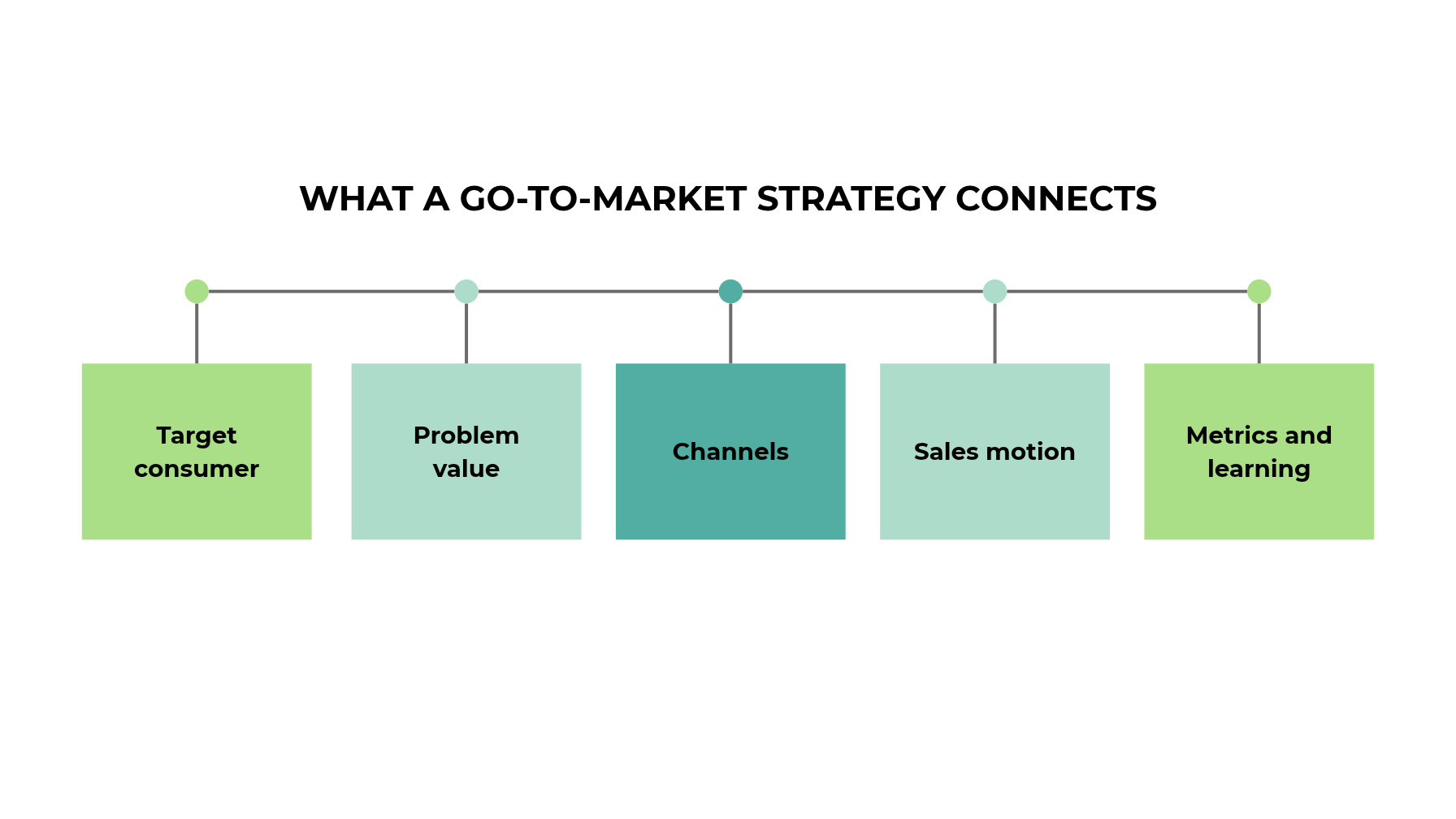
Components of a go-to-market strategy.
A useful strategy makes those choices explicit. For example: We will serve this type of customer, who is dealing with this specific problem. We will show how our offer addresses it, reach buyers through these channels, and measure progress using these indicators.
That statement is not a complete plan. It is a starting point your team can test against real customer conversations and results. Salesforce’s overview of go-to-market strategy also describes GTM as a coordinated plan involving areas such as the market, customer, channel, and pricing.
What’s the difference between a GTM strategy and a business plan?
A business plan describes the broader business; a GTM strategy explains how a particular offer will reach customers and generate revenue. They answer related but different questions.
A business plan might cover the company’s purpose, market opportunity, product, operations, financing, and long-term goals. A GTM strategy gets more specific about a commercial bet: which customers to target, how to reach them, what to say, how to sell, what to charge, and how to deliver.
You need both kinds of thinking. A business plan can describe a promising market without explaining how your team will win customers there. A GTM strategy can lay out a route to market without replacing the company’s broader financial and operational plans. Harvard Business School’s startup guidance on go-to-market strategy emphasizes understanding the customer, the problem, and the buying journey as practical inputs to those choices.
When should a startup build one?
Start working on your go-to-market strategy while you are learning about customers, not after the product is finished. Early GTM work is a set of hypotheses to test, not a polished document you need to get right once.
Before launch, try to learn:
Which customers experience the problem most acutely?
What do they do about it today?
Who is involved in choosing or approving a solution?
What would make them willing to try or pay for yours?
Where can you reach them and have a useful conversation?
That work is especially important for founders doing sales for the first time. Early customer conversations can change your target segment, message, price, or even the problem you thought you were solving. The goal is not to prove your first assumptions right. It is to discover what customers respond to and what your team can deliver consistently.
As the business gains evidence, the questions change. Can you attract the right customers more than once? Can your team move them through a sales process that works? Can you deliver the promised value? Before you invest heavily in a larger sales or marketing structure, look for signs that the motion is repeatable.
I’ve built sales organizations from scratch in early-stage environments and led sales and GTM work across Microsoft, IBM, Samsung, Rockwell Automation, FedEx, and Wipro. The context varies, but the discipline is similar: understand the customer, connect strategy to realistic numbers, and make sure the team can execute the plan.
At Rockwell Automation, the work contributed to $80M in year-one revenue. At Microsoft, I helped increase Dynamics 365 pipeline by 85%. Those are outcomes from specific environments, not benchmarks to assume for your company. The practical lesson is that strategy has to connect to a real path through customers, pipeline, and execution.
How do you make a GTM strategy useful to your team?
Make it useful by translating it into clear decisions, owners, and measures. Your team should be able to explain who you are targeting, what value you promise, how customers move toward a decision, and what evidence will tell you whether the plan is working.
I use the GTM Clarity Framework™ to organize that work:
GTM Health Assessment: Understand how the current revenue engine is working, including its strengths and constraints.
Tie Strategy to Realistic Numbers: Connect growth goals to the pipeline and activity required to pursue them.
Scalable Growth Structure: Establish the roles, process, and operating structure needed for the next stage.
Predictable Aligned Execution: Align teams around how the strategy will be carried out.
Performance KPIs: Use clear measures to see progress and identify where to adjust.
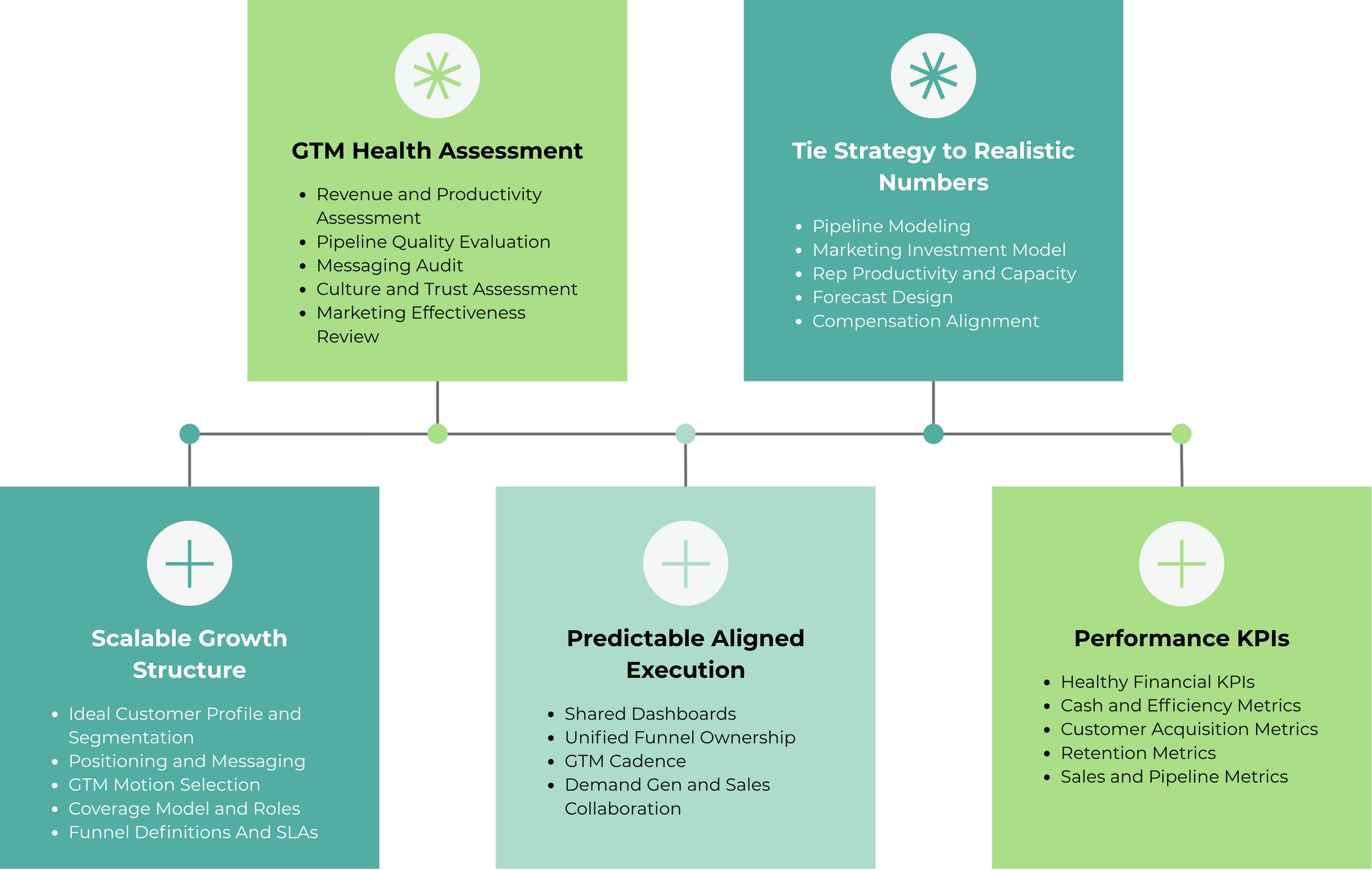
The GTM Clarity Framework™.
You do not need a long plan to begin. You do need alignment on the assumptions that matter most, and a way to revisit them when customer evidence or performance says they need to change. This is how GTM moves from a set of slides to a system your team can use.
Frequently asked questions about go-to-market strategy
Is a go-to-market strategy only for launching a new product?
No. You can use one to launch a product, enter a new market, refine an existing sales motion, or address stalled growth. The focus is a specific customer and a route to serving them.
Is a GTM strategy the same as a marketing strategy?
No. Marketing may be one part of GTM, but GTM also includes the customer, offer, pricing, sales or buying motion, delivery, and measurement. It connects those activities rather than treating them as separate plans.
What does GTM stand for?
GTM stands for go-to-market. “GTM strategy” is simply a shorter way to refer to a go-to-market strategy.
Does every startup need a formal GTM plan?
Every startup needs to make GTM decisions, but not every startup needs a detailed formal plan at the beginning. Start with testable assumptions, learn from customers, and add structure as you find evidence of a repeatable motion.
How often should a company revisit its GTM strategy?
Revisit it when customer behavior, results, or business priorities show that an assumption may no longer hold. Regular review of pipeline, conversion, customer feedback, and delivery can help your team spot where to investigate.
What is the first step in creating a go-to-market strategy?
Get specific about the customer and the problem. Talk with the people who experience it, learn how they address it today, and use what you hear to shape your offer and route to market.
◆◆◆
If you want a grounded view of where your GTM stands and what to prioritize, learn about Diagnostic Days or book a conversation.
