

If you’re deciding between a fractional CRO and a full-time hire, start with the work ahead, not the title. A fractional CRO can help you diagnose and build a revenue system before you need a permanent executive. A full-time CRO makes more sense when you need one leader owning execution, people, and the revenue number every day.
A fractional chief revenue officer (CRO) is an experienced revenue leader who works with your company part-time. A full-time CRO is a permanent executive responsible for leading revenue operations and results on an ongoing basis.
For many seed and early Series A companies, there’s a third option: neither. If you have not found a sales motion you can repeat, founder-led selling and focused commercial support may be a better next step than adding a senior executive.
What does a fractional CRO actually own?
A fractional CRO should own a defined business problem and a clear set of outcomes, not an open-ended promise to “grow revenue.”
Depending on what your company needs, that work might include:
Reviewing your ideal customer profile (ICP), segments, and positioning
Assessing pipeline quality, sales stages, and forecast practices
Clarifying pricing, packaging, and the sales process
Setting priorities for your go-to-market (GTM) structure and metrics
Coaching you or an existing sales leader through execution
Defining what role to hire next, and what that person should own
The practical distinction is the scope of the commitment. In my Fractional CRO work, I dedicate one day a week to meetings, strategic guidance, and execution support, with additional advisory support between sessions. That can give a founder access to experienced leadership without creating a full-time executive role before the work requires one.
My approach is to assess the current engine, tie strategy to realistic numbers, and build the structure for aligned execution. The work should leave your team clearer on what to do and why, not dependent on a consultant to keep moving.
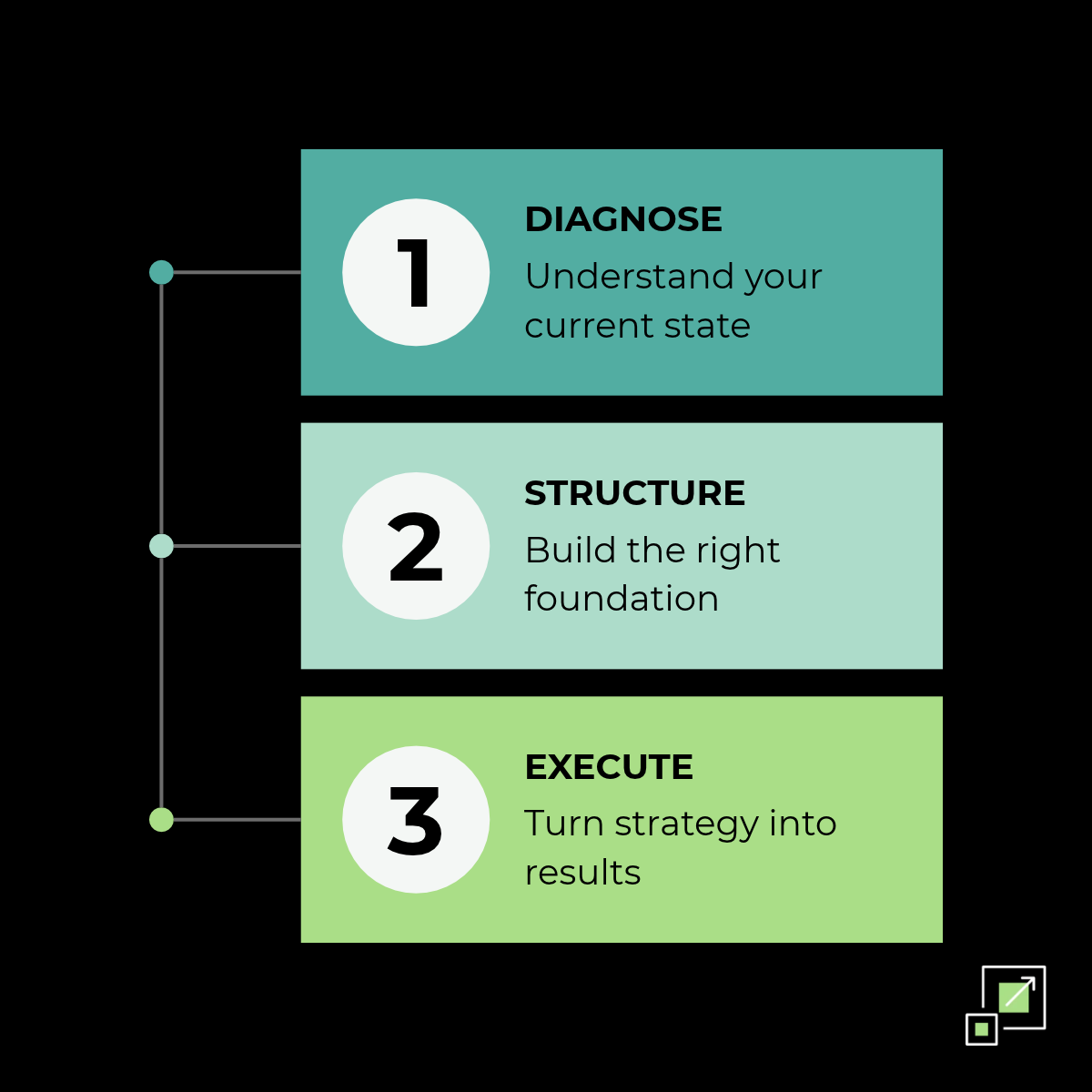
My approach to building a scalable, sustainable revenue engine.
When does a full-time CRO make more sense?
A full-time CRO makes more sense when the company needs continuous executive ownership, not just periodic senior guidance.
Look for signs like these:
Your sales motion is repeatable enough to scale, and you have evidence to support that conclusion.
You need to recruit, manage, and coach a growing commercial team every week.
Several revenue functions or leaders need ongoing coordination.
The CEO cannot keep owning the commercial plan and sales decisions.
Your board and leadership team need one accountable owner for the revenue plan and forecast.
The work ahead is mostly sustained execution, not figuring out what the system should be.
A funding round alone does not make it time to hire a CRO. The question is what the business needs this person to do after they start.
Early startup hiring guidance has long cautioned against hiring senior sales leadership before there are customers and evidence of a sales motion. One guide to early sales hiring suggests waiting until a company has 10 to 20 customers before hiring a VP of Sales. Treat that as a useful prompt, not a universal threshold. Your sales cycle, customer type, and complexity matter too.
What does each cost in practice?
A fractional CRO typically costs less in direct cash than a full-time executive, but the comparison only helps if you account for the time and scope you receive.
| Fractional CRO | Full-time CRO | |
|---|---|---|
| Commitment | Part-time, set by the engagement | Full-time, ongoing |
| Cost | Published guides often quote $6,000–$15,000 per month, depending on scope and time | Technology-market benchmarks commonly put base salary in the $250,000–$400,000 range, before incentives and other employment costs |
| Scope | Defined priorities, strategic leadership, and execution support within agreed availability | Continuous leadership across revenue planning, people, and day-to-day execution |
| Best stage | You need senior help to assess or build the system, but not a permanent executive yet | You have a team and motion that require ongoing leadership and accountability |
These figures are directional, not quotes. A fractional CRO pricing guide describes typical retainer ranges, while a technology executive compensation benchmark offers a view of full-time pay. Scope, experience, location, incentives, benefits, and equity all affect the actual cost.
A 2025 fractional sales leadership survey reports average compensation of $11,732 per month and an average weekly commitment of 14.6 hours. That survey covers fractional sales leaders broadly, not CROs alone, so use it as context rather than a CRO-specific rate card.
Remember to compare availability as well as dollars. A fractional leader does not provide five-day coverage by default. If your team needs daily decisions, constant recruiting, or hands-on management across several functions, a lower monthly fee may not meet the need.
How do you decide?
Decide based on the next 6 to 12 months of work. Ask what the business needs its revenue leader to do every week, and whether the company has enough evidence and capacity to support the answer.
Consider fractional leadership if:
You need to clarify the ICP, positioning, process, pricing, or forecast before scaling.
You need senior judgment but have a small team.
You can commit to executing between working sessions.
You can define success as specific outputs, such as a GTM assessment, hiring plan, or operating cadence.
Consider a full-time CRO if:
You need one executive to own the revenue plan continuously.
Your company is ready to recruit and lead a larger team.
You have a repeatable motion and enough pipeline to support further investment.
The CEO has become a bottleneck for revenue decisions.
Consider neither for now if:
You are still learning who buys, why they buy, and how you can reach them.
You have too few customer conversations to judge whether the motion works.
The immediate gap is sales capacity, not executive leadership.
In this situation, the founder may need to stay close to customers while adding a first seller or targeted advice. I have seen how important it is to distinguish genuine demand from revenue that comes mainly through a founder’s network.
Across more than 20 years of sales, marketing, and go-to-market leadership, including work at Microsoft, IBM, Samsung, Rockwell Automation, FedEx, and Wipro, I have built sales organizations from scratch that generated $80 million in year one at Rockwell Automation, and led work that increased Dynamics 365 pipeline by 85% at Microsoft. The lesson is not that one leader or one hire guarantees those results. It is that growth needs a system grounded in the company’s actual buyers, pipeline, and capacity.
A short diagnostic can help you decide which path fits before you commit to an executive hire. My Diagnostic Days are a 1–2 day immersion that ends with a strategic assessment and prioritized next steps. If the need is more sustained, Fractional CRO support offers a part-time operating partnership.
Frequently asked questions
Is a fractional CRO the same as an interim CRO?
Not necessarily. “Fractional” usually means an ongoing part-time commitment. “Interim” usually means temporary full-time leadership while a company transitions between permanent executives. Confirm time commitment and decision authority rather than relying on the title.
When should a startup hire a CRO?
Hire one when the company needs a dedicated executive to lead revenue continuously and can support the scope of the role. At seed or early Series A, that need may not exist yet. A fractional leader, first sales hire, or continued founder-led sales may fit better.
Can a fractional CRO own a revenue number?
They can, if the engagement explicitly gives them the authority, access, and time to do so. Clarify whether the role is advisory, operational, or accountable for a target. Do not assume “CRO” means full ownership in a part-time arrangement.
How long should a fractional CRO engagement last?
Set the term around the work and outcomes, not a standard duration. Define the first 90 days, review progress regularly, and agree on whether the engagement should end, continue, or transition to a full-time hire.
Is fractional CRO support cheaper than hiring full-time?
It is often less expensive in direct cash, but it also provides less time and availability. Compare the total cost with the actual scope, including what the company still needs to do internally.
What to do next
Write down the three revenue problems you need solved in the next 90 days. Then decide whether those require focused senior guidance, an executive working full-time, or more customer learning before either hire. I use the GTM Clarity Framework™ to ground that decision in your current engine, not assumptions. Learn about Diagnostic Days and Fractional CRO support, or book a conversation.
