

The first 90 days of go-to-market should help you identify a specific customer and urgent problem, test whether people will commit to a solution, and establish a practical next step based on evidence. The goal is not to look big. It is to learn what can work.
Go-to-market strategy for startups is the plan for how you’ll reach a specific customer, address a real problem, and turn that value into a repeatable path to revenue. In the first 90 days, treat it as a set of hypotheses to test, not a finished document.
This 30/60/90-day plan is a starting point, not a universal formula. Your sales cycle, product readiness, and customer access will shape the pace. Each week, talk to customers, record what you learn, and decide what to test next. That discipline is at the heart of my GTM Clarity Framework™: assess the current state, tie strategy to realistic numbers, build the right structure, and execute against useful performance measures.
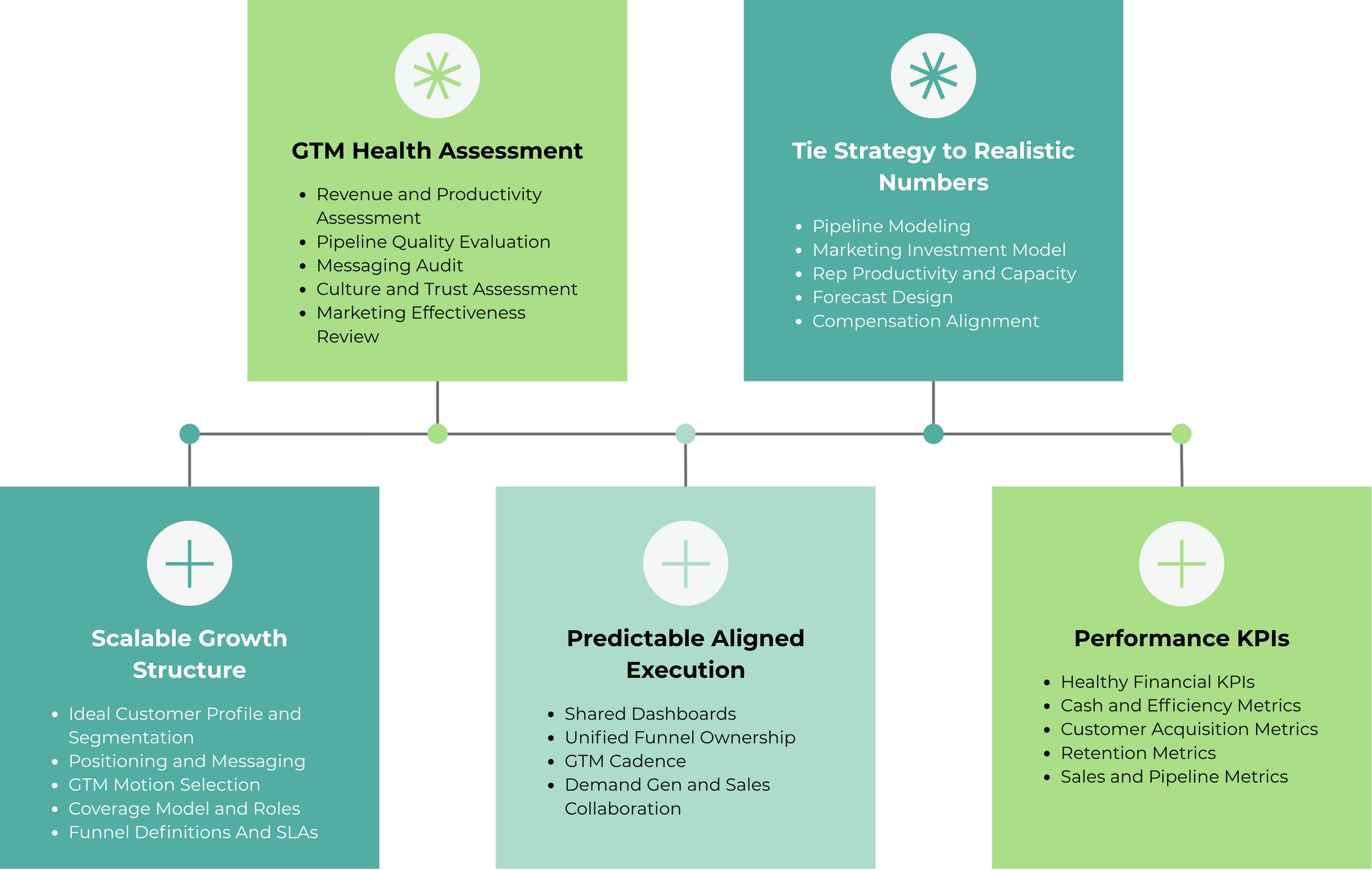
The GTM Clarity Framework™.
What should the first 30 days focus on?
Use the first month to narrow your target customer, understand their problem, and test whether your proposed value is compelling enough to earn a concrete next step.
Start with an ideal customer profile (ICP): a specific kind of organization or buyer, in a clear situation, with a problem your product can address. Avoid descriptions so broad they include nearly anyone.
Week 1: Choose a customer and write down your assumptions.
Draft a one-sentence ICP and a plain-language problem statement. List the assumptions behind them: who feels the problem, who pays to solve it, what they do today, and how they find solutions. Then build a short interview guide. Ask about the last time the problem happened, what it cost, and what the person did about it. Don’t start with a product demo.
Week 2: Interview people in and beyond your network.
Speak with prospective users and buyers. Your own contacts can help you get started, but include people who don’t already know you. Listen for patterns in recent behavior: workarounds, delays, existing spend, or effort spent managing the problem. Record the language people use. It may be more useful than your current messaging.
Week 3: Test the offer before you build more.
Create the simplest thing that helps a prospect react to your proposed value: a prototype, sample output, mock-up, or manual version of the service. Ask for a specific next step, such as a follow-up with the budget owner, a pilot discussion, or access to information needed to evaluate the solution. Compliments are pleasant, but they don’t tell you whether someone will act.
Week 4: Choose what to test next.
Review what you heard. Which customer group described a recent, meaningful problem? Which prospects took a real step forward? Adjust your ICP, problem statement, or offer based on that evidence. End the month with a focused segment, a short list of promising prospects, and the biggest unanswered question you want the next month to resolve.
The Harvard Business School’s go-to-market overview also highlights the importance of understanding the customer, problem, purchasing journey, and how you’ll reach prospects. Those are useful questions to bring into founder-led discovery.
What should days 31-60 accomplish?
In the second month, use what you learned to create a small, focused offer and put it in front of real prospects. The aim is to learn whether they’ll use it, pay for it, or give you a clear reason they won’t.
Week 5: Turn learning into a clear message.
Write a short explanation of who the product is for, what problem it addresses, and what changes for the customer. Keep it specific. Test it in conversations and notice where people ask for clarification or lose interest. If most early introductions come from your network, be careful not to mistake that access for evidence of broader demand.
Week 6: Define the smallest useful pilot.
Choose one customer problem and one outcome to focus on. Agree with pilot prospects on what they’ll try, when they’ll try it, what success means, and what you’ll each contribute. If the pilot is free, be explicit about how and when you’ll discuss paid use.
Week 7: Get the pilot into customers’ hands.
Onboard participants directly. Watch how they use the product or service and where they get stuck. Track the measures that matter for your offer: time to first value, whether they complete the core task, how often they return, and what support they need. Don’t assume a feature request explains the underlying problem.
Week 8: Review what happened and ask for commitment.
Talk to active and inactive pilot users. What value did they get? What stopped them? Ask active prospects whether they’ll pay, continue under agreed terms, introduce you to another buyer, or take another defined step. If they won’t, understand why before adding features or increasing outreach.
Use a simple weekly scorecard. It might include qualified conversations, pilots started, prospects who reach the intended outcome, and paid commitments. Choose measures that match your business; don’t copy targets that don’t fit your stage or sales cycle.
What should days 61-90 prove?
The final month should test whether you can repeat your most promising early sales motion, and help you decide what to continue, change, or stop.
Week 9: Select one way to reach more of the right people.
Choose one channel to test, such as direct founder outreach, referrals, a relevant community, or a partner relationship. Pick it based on where your target customers are and how you can learn from them. Define who you’ll contact, what you’ll say, and what a useful response looks like before you begin.
Week 10: Repeat the test with a fresh group.
Use the same customer profile and message long enough to learn from the results. Track qualified conversations and next steps, not just views or clicks. If the response is weak, investigate whether the issue is your audience, timing, message, offer, or channel.
Week 11: Tighten the path from conversation to customer.
Write down the basic stages a prospect moves through: first conversation, qualification, evaluation, decision, and onboarding. Note the questions and objections that recur. This doesn’t need to be a complex sales process. It should help you know what to do next with each opportunity.
Week 12: Check whether the economics and delivery make sense.
Estimate how much founder time and direct cost it takes to win and support a customer. Compare that effort with your pricing and the value you’re delivering. At this stage, estimates are just that. Make assumptions visible rather than building a forecast on false precision.
Week 13: Make a grounded decision.
Summarize what you learned: the strongest customer segment, recurring problems, customer commitments, product usage, channel results, and open questions. Then choose whether to continue with the current approach, change an important assumption and test again, or stop. Set one clear priority for the next quarter.
What do startups get wrong in their first 90 days?
The most common mistake is treating activity as proof of demand. A launch, a busy calendar, and positive feedback may feel encouraging, but they don’t answer whether the right customer has a meaningful problem and will commit to solving it.
I also see founders try to validate too many things at once. If you change the customer, message, price, product, and channel together, it’s difficult to know what caused a change in results. Keep the test narrow enough to learn from.
A few practical guardrails:
Don’t build a broad feature set before you understand the customer’s core problem.
Don’t treat free sign-ups or compliments as a substitute for customer commitment.
Don’t hire a sales team before you know what you need them to repeat.
Don’t turn early revenue from your personal network into a claim of repeatable demand.
I’ve spent more than 20 years in sales, marketing, and go-to-market leadership across Microsoft, IBM, Samsung, Rockwell Automation, FedEx, and Wipro, including building sales organizations from scratch. At Rockwell Automation, the business generated $80 million in year one; at Microsoft, I led work that increased Dynamics 365 (D365) pipeline by 85%. Those are outcomes from specific contexts, not benchmarks or promises for a startup. The lesson I carry into early-stage work is to connect ambition to what customers do and what the team can actually execute.
My work with founders through the Accelerator & Founder Program applies the same principle: build commercial structure from real customer evidence, not assumptions.
Frequently asked questions
Is 90 days enough to find product-market fit?
Not necessarily. Ninety days can create meaningful evidence about your customer, problem, offer, and early sales motion. It doesn’t guarantee product-market fit. Your next steps should reflect what the evidence does, and doesn’t, show.
Should a startup hire a salesperson during its first 90 days?
Usually, the founder should lead early customer conversations. That lets you learn directly how prospects describe the problem, what concerns they raise, and what makes them move forward. Consider a hire when the sales motion is clearer and you can explain what the person should repeat.
How many customer interviews should I do?
There’s no right number for every startup. Start with enough conversations to spot patterns, and keep interviewing when key assumptions remain unclear. Pay attention to what people have done, not only what they say they might do.
What should I measure during the first 90 days?
Choose a small set of measures tied to your goals. Useful early indicators can include qualified conversations, pilots started, customer activation or completion of a core task, paid commitments, and the time needed to acquire and support a customer.
What if prospects like the product but won’t pay?
Ask what blocks the decision: the problem’s urgency, budget, buyer, timing, trust, or the value of the offer. A refusal can be useful evidence. Use it to decide what to test next rather than assuming that more features will solve the issue.
◆ ◆ ◆
Your first 90 days don’t need to prove you can scale. They should give you a clearer customer, a sharper offer, and a next-quarter plan grounded in evidence. My Accelerator & Founder Program supports founders working through these commercial foundations; book a conversation.
