
A GTM strategy framework is a practical way to connect your market choices and revenue goals to the people, processes, and measures needed to execute. It should link strategy to realistic numbers, clarify who does what, and give your team a way to adjust based on results, not just produce a polished slide.
Definition: A go-to-market strategy framework is a repeatable structure for deciding where to focus, how to reach and serve customers, how to organize execution, and how to measure progress.
A framework earns its keep when your team can use it to make decisions this quarter. If it only describes your company in four boxes, it may be a useful starting point, but it is not yet an operating plan.
What does a GTM strategy framework include?
A useful framework connects five parts of the revenue engine: its current health, the numbers behind the goal, the structure required to deliver, the team’s execution, and the measures that show what is working.
I built the GTM Clarity Framework™ around that sequence. It is an operator-built diagnostic alternative to generic models that may help organize a market or product conversation but don’t necessarily show how your team will deliver revenue.
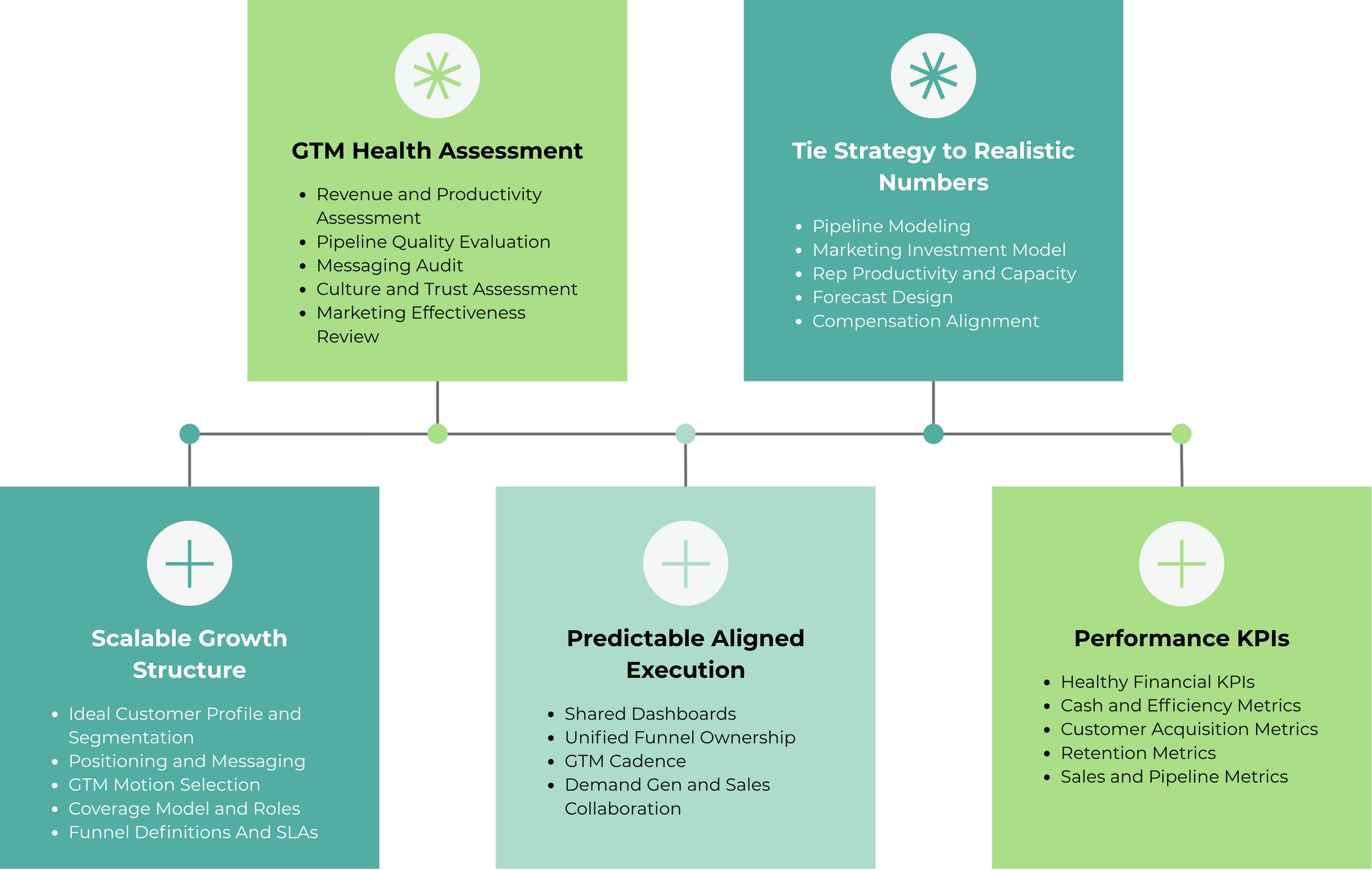
The GTM Clarity Framework™.
The five stages are:
GTM Health Assessment — Understand the current state before prescribing a fix. Look at pipeline quality, conversion, forecast reliability, messaging, marketing effectiveness, and customer and segment fit.
Tie Strategy to Realistic Numbers — Work backward from the goal. Make assumptions visible: deal size, win rate, sales cycle, capacity, and the pipeline needed.
Scalable Growth Structure — Clarify the roles, handoffs, process, and systems needed to support the chosen go-to-market approach.
Predictable Aligned Execution — Put the plan into action with shared priorities, clear ownership, and a regular operating cadence.
Performance KPIs — Track a focused set of measures that helps the team spot gaps and decide what to do next.
The order matters. Setting targets without understanding the current engine can create a plan based on hope. Adding people before clarifying the work can add cost without resolving the constraint. Measurement is most useful when the team can act on what it shows.
How do you use a GTM framework in a quarter?
Use the framework as a 90-day sequence: diagnose first, set a grounded plan, align the system, execute, and review. The exact timing depends on your sales cycle and resources, but the work should lead to decisions, not just meetings.
Weeks 1–2: Assess the current state. Start with evidence from your funnel, customers, and team. Review recent wins and losses, pipeline stages, forecast changes, lead sources, and customer retention or expansion where relevant. Ask whether the customers you win are the customers you want more of. Capture the biggest friction points and the assumptions you need to test.
Weeks 3–4: Tie the goal to the numbers. Choose one primary commercial outcome for the quarter, then work backward using your own data. If the goal is new revenue, check whether the opportunity volume, deal size, conversion rates, sales cycle, and team capacity make the target plausible. If you don’t have reliable historical data, write down the assumptions rather than presenting them as facts.
Weeks 5–6: Set the growth structure. Decide which customer segments and sales motions matter most this quarter. Define ownership and handoffs among sales, marketing, customer success, and leadership. Make sure your CRM stages mean the same thing to the people who use them. A pipeline stage should reflect an observable buyer or deal condition, not just a salesperson’s optimism.
Weeks 7–10: Execute and inspect. Keep the plan small enough to run. Choose the campaigns, account plays, or sales activities that support your priority segment. Use a weekly review to inspect pipeline quality, stage movement, stalled deals, and next steps. Use those reviews to make decisions: what to continue, what to change, and what to stop.
Weeks 11–13: Review performance and reset. Compare results with the original goal and assumptions. Identify where the plan held up and where reality differed. Carry those findings into the next quarter’s segment choices, capacity plan, and forecast.
A simple GTM strategy template can fit on one page:
Quarterly outcome: What result matters most?
Priority segment: Which customers are we focusing on, and why?
Customer problem and message: What specific need are we addressing?
Revenue assumptions: What deal size, conversion, and cycle assumptions support the goal?
Execution plan: Which plays will we run, and who owns each?
KPIs and review cadence: What will we inspect weekly and quarterly?
Risks and decisions: What evidence would make us adjust?
A practical GTM planning overview can help you compare common planning elements. Keep the template tied to your team’s actual business. A complete-looking document is not a substitute for checking your assumptions.
Which GTM frameworks are worth using?
Different tools help answer different questions. The 4Ps can prompt a discussion about product, price, place, and promotion. A SWOT can surface perceived strengths, weaknesses, opportunities, and threats. A four-box matrix can help teams sort customers, products, or priorities.
Those tools can be useful, but they do not automatically connect market choices to revenue capacity, operating structure, execution, and performance measures. That connection is the work a go-to-market strategy framework needs to support.
I designed the GTM Clarity Framework™ to bring those operating questions together. It reflects more than 20 years of sales, marketing, and GTM leadership across Microsoft, IBM, Samsung, Rockwell Automation, FedEx, and Wipro. My experience includes building revenue engines from scratch, including $80M in year one at Rockwell Automation and an 85% D365 pipeline increase at Microsoft. Those are specific outcomes from my work, not a promise that another team will produce the same results. The point is to start with the business in front of you and build a plan its people and numbers can support.
How do you know if your framework is working?
A framework is working when it helps your team make better, clearer decisions, not just when the plan is complete. Look for evidence that your GTM choices and execution are becoming more aligned.
For example:
Your team can explain which customers are priorities and why.
Revenue targets connect to stated assumptions about pipeline, conversion, and capacity.
Handoffs and ownership are clear enough to act without repeated clarification.
Meetings focus on pipeline movement and decisions, not only status reporting.
Your KPIs reveal a problem early enough for the team to respond.
At quarter end, you can name what you learned and what will change next.
Choose measures that fit your motion. Depending on the business, that might include qualified pipeline created, stage conversion, sales-cycle length, win rate, forecast accuracy, retention, or expansion. Don’t track a long list because it looks comprehensive. A smaller set of useful measures is easier to review and act on.
Frequently asked questions
Is a GTM strategy framework the same as a go-to-market strategy?
No. The strategy describes the choices your company makes about customers, value, channels, and growth. The framework gives you a structure to connect those choices to planning, execution, and measurement.
How long does it take to build a GTM strategy framework?
You can use a quarterly planning cycle to assess the current engine, set priorities, and establish a working plan. The first cycle may expose missing data or unclear processes; improving those can take longer than a quarter.
Can an early-stage startup use this framework?
Yes. An early-stage company can use the same stages at a smaller scale. Start with the evidence you have, make assumptions explicit, and revisit them as you learn from customer conversations and sales.
What should I include in a GTM strategy template?
At minimum, include the quarter’s outcome, priority segment, customer problem and message, revenue assumptions, execution owners, measures, review cadence, and the risks that could change your plan.
How often should we revisit the framework?
Review execution measures regularly, often weekly, and revisit strategic assumptions at least quarterly. Reassess sooner if customer evidence, pipeline, or team capacity shows that the plan no longer fits.
◆◆◆
Start with the gap your team most needs to resolve, then work through the five stages in order. If you need help diagnosing your current GTM engine and setting priorities, Diagnostic Days provide an assessment with prioritized next steps. You can book a conversation.
