

A go-to-market consultant helps a company work out how to reach the right customers, explain its value, and turn sales activity into a repeatable revenue motion. They assess what’s working and what isn’t, then help leadership prioritize practical changes to strategy, process, and execution. The goal isn’t another generic strategy deck. It’s a clearer path forward that your team can act on.
What does a go-to-market consultant actually do?
A consultant looks across the parts of your business that influence revenue. That can include your target customer, positioning, pipeline, sales process, marketing activity, team structure, and performance measures. They connect those pieces to understand where the go-to-market engine is strong and where it is getting stuck.
Depending on the company’s needs, the work may include:
Reviewing the ideal customer profile (ICP), customer segments, and use cases
Clarifying positioning, messaging, and sales conversations
Evaluating pipeline quality, forecasting, and funnel conversion
Reviewing pricing, packaging, and the way the offer is presented
Assessing how marketing and sales work together
Defining roles, handoffs, operating routines, and performance KPIs
Recommending what to fix first, who should own it, and how to measure progress
A sales audit may be part of the work, but a go-to-market consultant usually looks beyond sales activity alone. For example, inconsistent pipeline might point to unclear qualification, the wrong target segment, a message that fails to resonate, or a combination of issues. The consultant helps investigate the cause before recommending a solution.
A good go-to-market strategy consultant also adapts the analysis to the company’s stage. Early-stage teams may need help with founder-led sales, customer focus, and the basics of a commercial process. Growing companies may need to understand why a previously successful approach has stopped producing consistent results.
Signs you may need a go-to-market consultant
You might benefit from outside GTM support when:
The founder is still driving every deal. Founder-led sales can be valuable early on. It becomes a constraint when the team can’t explain or repeat what makes those deals succeed.
Your target customer is too broad. You see several possible markets, but lack a clear basis for deciding where to focus.
Activity isn’t translating into a reliable pipeline. Sales and marketing are busy, but it’s difficult to connect that effort to qualified opportunities and revenue.
Growth has stalled and the cause is unclear. You’re not sure whether the issue is messaging, pipeline quality, sales execution, team structure, or something else.
Your forecast doesn’t feel dependable. Pipeline stages, deal assumptions, or ownership may not provide a useful view of what is likely to close.
You’re preparing to scale or enter a new market. You want to test whether the current approach is ready to expand before adding people or spending.
A consultant may be less useful if you’re still validating whether customers have a real need for the product. In that case, direct customer conversations and founder-led learning may need to come first. And if you already know what needs to change but need someone to lead the revenue team every week, you may be looking for an operating leader rather than a project-based consultant.
What a real engagement can look like, week by week
Every engagement depends on the company’s scope, access to information, and decision-making needs. Here’s an illustrative four-week project structure, not a fixed timeline or package.
Week 1: Understand the current state. The consultant meets with leadership and relevant team members, reviews available sales and marketing materials, and examines pipeline, forecasting, messaging, and customer segments. The first task is to understand what’s happening, not to arrive with a predetermined answer.
Week 2: Identify the main constraints. The consultant connects the evidence and tests key assumptions. Is the company targeting the right buyers? Do prospects understand the value? Are opportunities moving through a consistent process? This is where a focused diagnostic or sales audit can help make the problem more specific.
Week 3: Set priorities. Leadership and the consultant decide which changes matter most and what can realistically be done with the team and resources available. Recommendations should be specific enough to assign owners and determine what progress will look like.
Week 4: Turn decisions into action. The engagement closes with a prioritized plan and working sessions to prepare the team to carry it forward. Depending on the scope, this might include clearer ICP criteria, revised sales messaging, funnel definitions, an operating cadence, or performance KPIs.
For a focused starting point, Amanda’s Diagnostic Days involve one to two days of immersion and observation, followed by a synthesized assessment and prioritized next steps. A larger engagement may include continued advisory or hands-on execution support.
A diagnostic approach, not a one-size-fits-all playbook
Amanda’s GTM Clarity Framework™ gives the diagnostic a structure while leaving room to account for the company’s actual situation. It covers the GTM Health Assessment, Strategy to Realistic Numbers, Scalable Growth Structure, Predictable Aligned Execution, and Performance KPIs. In practice, that means connecting strategic choices to realistic targets, team capacity, operating habits, and measurable outcomes.
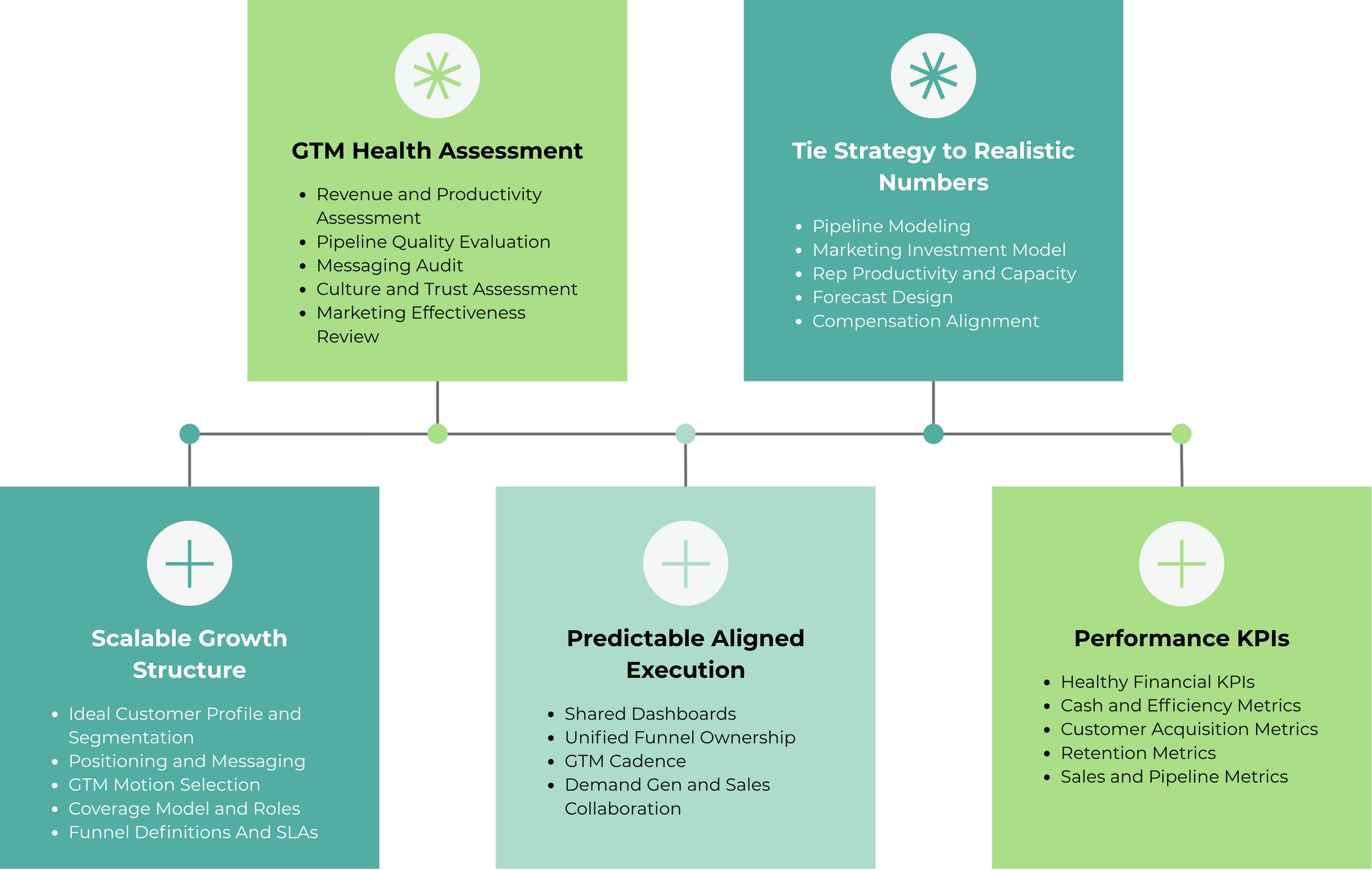
The GTM Clarity Framework™
The framework reflects more than 20 years of sales, marketing, and GTM leadership across Microsoft, IBM, Samsung, Rockwell Automation, FedEx, and Wipro, as well as experience building sales organizations from scratch in early-stage environments. That work includes $80M in year-one revenue at Rockwell Automation and an 85% increase in D365 pipeline at Microsoft. Past results are context, not a promise of what another company will achieve; the relevant question is what the evidence says about your business today.
Go-to-market consultant vs. fractional CRO vs. full-time hire
These roles can overlap, but the key difference is what you need someone to own.
| Role | Main Focus | Only a fit when... |
|---|---|---|
| Go-to-market consultant | Diagnoses challenges and recommends or supports defined improvements | You need clarity on what is limiting growth and what to prioritize |
| Fractional CRO or fractional sales leader | Provides ongoing, part-time revenue leadership and execution support | You need an experienced leader to help run the revenue motion without a full-time executive |
| Full-time CRO | Owns revenue leadership as a permanent executive role | The business needs dedicated, ongoing leadership and has the scope for a full-time hire |
A consultant’s engagement is generally defined by a specific problem or scope. A fractional CRO stays involved over time, helping lead execution, team alignment, and the operating cadence. A fractional sales leader may focus more narrowly on sales-team performance and process, depending on the role. A full-time CRO is a permanent member of the leadership team.
If your main question is “What’s getting in the way, and what should we do next?” a consultant may be a good starting point. If it’s “Who will guide the team and keep execution moving every week?” consider fractional leadership. Amanda’s Fractional CRO support is designed for companies that need more embedded strategic and execution support across the GTM engine.
What to ask before you hire a consultant
Before you commit, ask questions that help you understand the work, not just the credentials:
How will you diagnose our situation? Look for a clear explanation of how the consultant will review evidence, talk with the team, and understand your customers and sales motion.
What will we have at the end? Make sure the expected outputs are concrete, such as prioritized decisions, an execution plan, or defined metrics.
Who will help put the recommendations into practice? Clarify what the consultant will execute, what your team will own, and whether follow-on support is available.
How will we know the work was useful? Agree on the decisions, deliverables, or operating changes the engagement is meant to support.
What information and access will you need from us? The quality of the assessment depends in part on timely access to relevant people, processes, and data.
A useful engagement should leave your team with more than a presentation. It should help leadership make grounded decisions, assign ownership, and focus on the next steps that match the company’s stage.
Frequently asked questions
How much does a go-to-market consultant cost?
Fees depend on the scope, length, seniority, and level of implementation support. A focused diagnostic, a larger strategy project, and ongoing advisory are different kinds of work, so there isn’t one price that fits all engagements. Ask for a clear proposal outlining the work, deliverables, timeline, and any follow-on support before deciding.
Is a go-to-market consultant worth it for a startup?
It can be worthwhile when you have enough customer or sales evidence to identify real patterns, but need help turning that evidence into a more focused and repeatable approach. For startups, a consultant can help pressure-test go-to-market strategy for startups, including ICP, messaging, founder-led sales, and pipeline development. If you’re still validating the problem and customer need, start with customer discovery rather than assuming a broader strategy project will solve it.
What’s the difference between a GTM consultant and a fractional CRO?
A GTM consultant is typically brought in to assess a defined challenge and help the company make and implement specific changes. A fractional CRO provides ongoing, part-time executive leadership and helps the team manage execution over time. The right choice depends on whether your biggest need is diagnosis and direction, or sustained leadership and operating ownership.
◆◆◆
A go-to-market consultant can help you see whether the bottleneck is in your strategy, structure, or execution, and decide what to do next. If you want to discuss a diagnostic or ongoing support, you can learn more about my work or schedule a conversation.
